If you spend enough time exploring botanical products, you will eventually come across one word again and again:
Alkaloids.
You will see it on product descriptions, educational articles, laboratory reports, and conversations about plant chemistry.
But what are alkaloids? And more importantly, what does that word actually tell you about a botanical product? The answer starts with something simple: plants are far more chemically complex than they may appear.
A single plant can contain many naturally occurring compounds, each with its own chemical structure and characteristics. Alkaloids are one broad category within that chemistry, and they have been studied across an enormous variety of plants and other natural sources.
For consumers learning about Cat’s Claw, its naturally occurring alkaloids are an important part of understanding why the plant continues to attract scientific and botanical interest.
At Homiez Botanicals, we believe consumers deserve to understand the language behind the products they explore.
So let’s break it down.
What Are Alkaloids?
Alkaloids are a large and chemically diverse group of naturally occurring compounds characterized by the presence of nitrogen within their chemical structures. They are especially associated with plants, although alkaloids can also be produced by other organisms.
That definition can sound intimidating, so let’s simplify it. Think of a plant as its own miniature chemistry lab.
Inside that plant are many different compounds. Some are involved in basic processes necessary for growth and survival. Others are often described as specialized metabolites: compounds produced through the plant’s metabolism that can differ significantly between species and tissues. Alkaloids are one major category of these specialized plant compounds.
Different plants can contain completely different alkaloids. And different alkaloids can have completely different chemical properties. That is one of the most important things to understand about the term:
“Alkaloid” does not describe one specific ingredient.
It describes a broad and diverse category of natural compounds.
You Probably Already Know Some Alkaloids
The word alkaloid may sound like something that only belongs in a chemistry textbook, but the category includes compounds associated with several familiar plants. One well-known example is caffeine. Coffee beans and tea leaves naturally contain caffeine, which is classified as an alkaloid.
Other plants contain entirely different alkaloids with their own structures and characteristics. The point is not that all alkaloids are similar. In fact, it is the opposite.
The alkaloid category includes an enormous diversity of compounds, and scientific reviews emphasize that alkaloids with related origins or structural similarities may still have different chemistry and biological activity.
So when you see a botanical product described as containing alkaloids, the next question should be:
Which alkaloids, and from which plant?
That is where the real conversation begins.
Why Do Plants Contain Alkaloids?
Plants produce a remarkable variety of chemical compounds through their natural metabolic processes. Researchers classify alkaloids among the specialized metabolites produced by plants and other organisms. Their structures and distribution can vary widely throughout the natural world.
Different plant species have evolved different chemical profiles. That is one reason botanical chemistry is so complex.
Two plants can grow in similar environments and still contain very different compounds. Even within a particular genus or species, researchers may investigate differences in chemical composition associated with plant material, genetics, geography, extraction methods, and other variables. For the modern botanical consumer, this leads to an important lesson:
Understanding a botanical product means looking beyond general terms and learning about the specific plant and chemistry involved.
What Do Alkaloids Have to Do With Cat’s Claw?
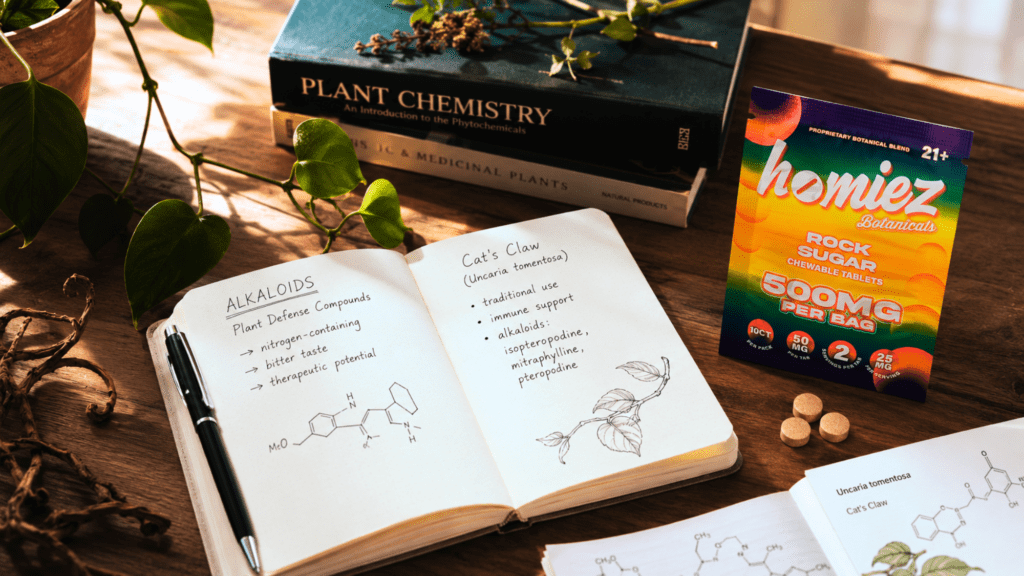
Cat’s Claw, scientifically known as Uncaria tomentosa, has a complex phytochemical profile. It is not defined by one single compound. Among the compounds discussed in scientific literature are several groups of alkaloids, including tetracyclic and pentacyclic indole and oxindole alkaloids, as well as other naturally occurring plant constituents. It is a chemically complex botanical with a profile that continues to be studied.
Wait, What Is an Oxindole Alkaloid?
This is another term you may encounter when reading about Cat’s Claw. An oxindole alkaloid is a type of alkaloid defined by features of its chemical structure.
Scientific literature on Uncaria tomentosa frequently discusses both pentacyclic oxindole alkaloids and tetracyclic oxindole alkaloids. Research has also examined variation between alkaloid-rich extracts and the importance of characterizing the chemical composition of the material being studied.
For consumers, the practical takeaway is straightforward: Not every plant extract is automatically identical simply because it comes from the same botanical species. The exact composition of a finished botanical ingredient can depend on multiple factors.
That is why responsible conversations about botanicals should focus on specific products, formulations, testing, and composition rather than making assumptions based only on the name of a plant.
Not All Alkaloids Are the Same
This deserves repeating.
Alkaloids are a category, not a single experience.
Caffeine is an alkaloid. Cat’s Claw contains alkaloids. Other familiar botanical species contain entirely different alkaloids.
That does not make those plants interchangeable. Their chemistry matters. Their botanical source matters. Their formulation matters. Their testing matters.
This is also why describing every botanical product simply as an “alkaloid product” leaves out most of the useful information.
A more educated consumer should ask:
- Where does the ingredient come from?
- What botanical species is being used?
- What does the product label actually say?
- Is serving information clearly communicated?
- Does the company make testing information available?
- Does the brand educate consumers responsibly?
The more botanical products evolve, the more important these questions become.
Why Botanical Education Matters
The modern botanical market is changing. Consumers have access to more products, more plant categories, and more information than ever before. But more information does not always mean better understanding. Scientific terms can quickly become marketing buzzwords when they are used without explanation.
At Homiez Botanicals, we believe education should make botanicals easier to understand, not more intimidating. You should not need a chemistry degree to ask reasonable questions about what is in a product.
At the same time, botanical chemistry should not be oversimplified to the point where different plants and compounds are treated as interchangeable.
Where Homiez Botanicals Fits In
Homiez Botanicals was created around a simple belief:
The botanical space should keep moving forward.
That means exploring new plants and compounds. It means developing convenient modern formats. It means taking complicated botanical conversations and making them approachable. And it means giving curious consumers more than a flashy package and a list of unfamiliar words.
Cat’s Claw is a plant with a long history and complex chemistry. Homiez Botanicals brings that botanical conversation into a modern product category built around innovation, potency, quality, and transparency.
For us, the future of botanicals is not about using scientific language to make products sound complicated. It is about understanding enough of the science to make the conversation clearer.
Start With the Plant. Understand the Chemistry.
So, what are alkaloids?
They are a broad and diverse group of naturally occurring compounds found throughout the natural world, particularly in plants. Different botanicals contain different alkaloids, and those chemical differences are part of what makes each plant unique.
For Cat’s Claw, alkaloids are one part of a much larger botanical story.
A story shaped by plant history, natural chemistry, scientific curiosity, and modern formulation.
This story is about a new generation of consumers who want to understand what they are exploring. The plant-powered space is bigger than most people realize.
We are just getting started.
Shop Homiez Botanicals